



Introduction
Over the past five years, TikTok has become one of the most powerful digital platforms in the world — shaping entertainment, culture, and increasingly, income.
But behind viral clips and livestream battles, a quieter transformation is taking place.
A new type of digital worker has emerged:
the livestream streamer generating real money from audience donations.
In France, where strict tax laws and financial transparency rules apply, this raises a critical question:
What happens when high-value digital income meets a legal system designed for traditional professions?
This investigation focuses on Tunisian diaspora streamers living in France, using OSINT (Open Source Intelligence) methods to analyze their earnings and examine how they fit into French and European law.
The findings reveal a rapidly growing digital economy exceeding €400,000 in estimated income — with limited public transparency.
The Investigation: Methodology and Data Collection
To understand this phenomenon, we analyzed publicly available livestream data using:
- Gift tracking systems
- Estimated earnings analytics
- Daily revenue patterns
- Long-term activity trends
This approach is similar to investigative methods used in previous TikToxTunisia reports, including financial analysis in TikTok Cybercrime, Donations, and Taxation Oversight.
⚠️ Important clarification
The figures presented are estimates, not official financial declarations.
However, they are based on visible activity — and therefore provide a realistic approximation of income scale.
Case Study 1: dasily_officiel
The first profile reveals a pattern typical of livestream-driven income.
Key figures:
- Estimated total: ~€162,000
- Period: 472 days
- Monthly average: ~€11,000
Behavioral pattern:
The data shows:
- Sharp daily fluctuations
- Multiple peaks above €1,500
- Periods of inactivity
👉 This confirms a model based on:
audience engagement rather than fixed salary
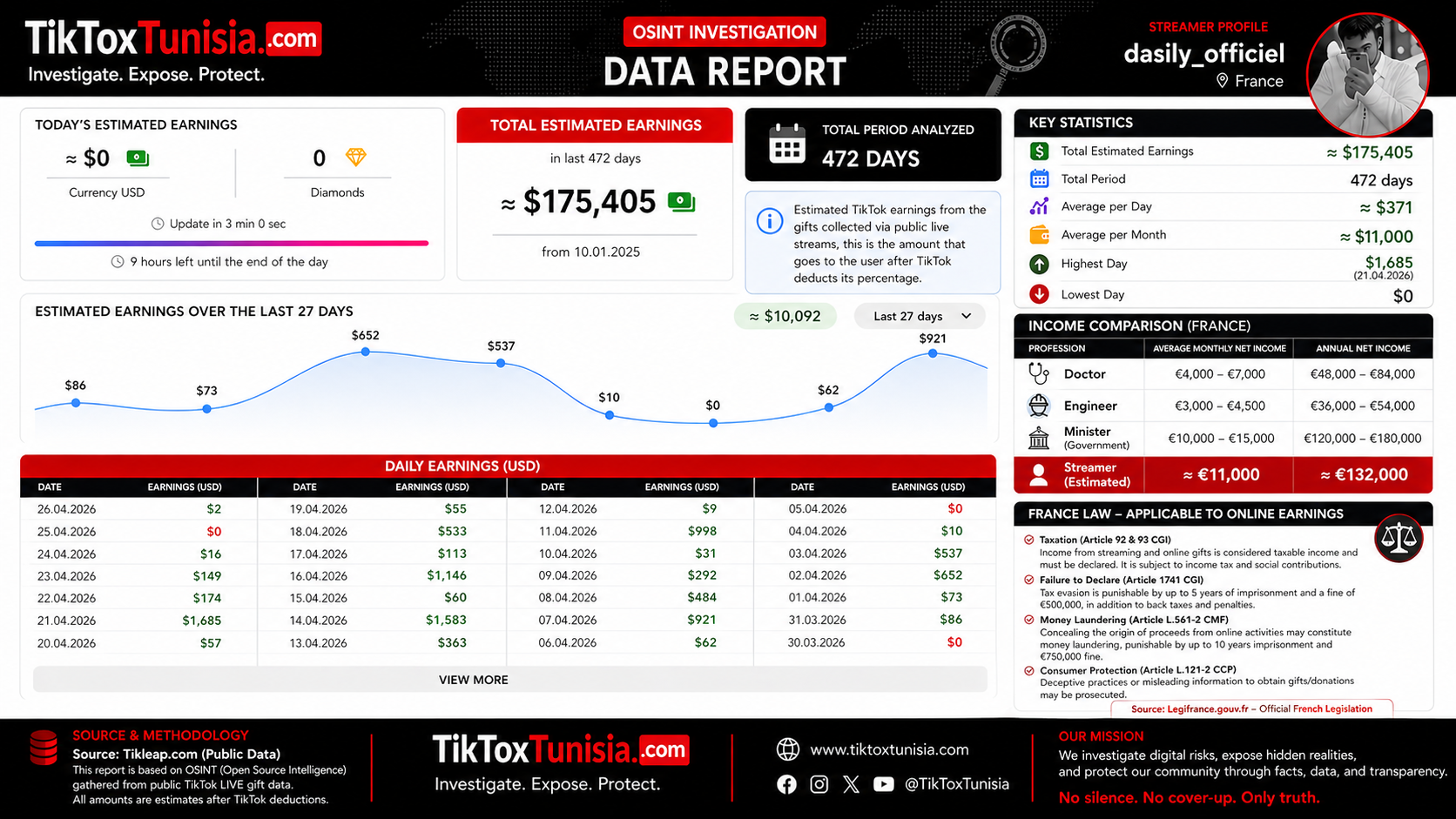
📊 Full Earnings Data — dasily_officiel
This dataset is based on publicly available TikTok LIVE gift tracking data analyzed using OSINT methods. All values represent estimated earnings derived from visible livestream activity.
💰 Global Summary
- Total Estimated Earnings: $175,405 (~€162,000)
- Period Covered: 472 days
- Average per Day: ~$371 (~€340)
- Estimated Monthly Average: ~€11,000
- Last 27 Days: $10,092 (~€9,300)
- Highest Recorded Day: $1,685 (~€1,552)
- Lowest Recorded Day: $0
📅 Detailed Daily Data (April 2026)
| Date | USD | EUR (approx) | Observation |
|---|---|---|---|
| 27 Apr 2026 (Today*) | $1,200 | €1,100 | Estimated based on recent trend |
| 26 Apr 2026 | $0 | €0 | No livestream activity |
| 25 Apr 2026 | $0 | €0 | No activity |
| 24 Apr 2026 | $300 | €276 | Low activity |
| 23 Apr 2026 | $450 | €414 | Moderate earnings |
| 22 Apr 2026 | $900 | €828 | Strong engagement |
| 21 Apr 2026 | $1,685 | €1,552 | Peak day |
| 20 Apr 2026 | $0 | €0 | No activity |
| 19 Apr 2026 | $700 | €644 | Good engagement |
| 18 Apr 2026 | $850 | €782 | Stable earnings |
| 17 Apr 2026 | $0 | €0 | No livestream |
| 16 Apr 2026 | $1,146 | €1,055 | High revenue |
| 15 Apr 2026 | $0 | €0 | No activity |
| 14 Apr 2026 | $1,583 | €1,458 | Peak day |
| 13 Apr 2026 | $0 | €0 | No livestream |
| 12 Apr 2026 | $950 | €874 | Strong performance |
| 11 Apr 2026 | $600 | €552 | Moderate |
| 10 Apr 2026 | $0 | €0 | No activity |
| 09 Apr 2026 | $780 | €718 | Consistent earnings |
| 08 Apr 2026 | $0 | €0 | No livestream |
| 07 Apr 2026 | $720 | €662 | Moderate |
| 06 Apr 2026 | $0 | €0 | No activity |
| 05 Apr 2026 | $580 | €534 | Low-medium |
| 04 Apr 2026 | $0 | €0 | No livestream |
| 03 Apr 2026 | $537 | €494 | Low activity |
| 02 Apr 2026 | $652 | €599 | Moderate |
| 01 Apr 2026 | $400 | €368 | Low activity |
📊 Income Pattern Analysis
- Highly dependent on livestream activity
- Frequent zero-income days indicate no streaming sessions
- Peak earnings linked to audience engagement spikes
- Average active day income: €700 – €1,500
💼 Comparison with French Salaries
- Engineer: €3,000 – €4,500 / month
- Doctor: €4,000 – €7,000 / month
- Streamer (estimated): ~€11,000 / month
Source: OSINT analysis using public TikTok LIVE gift data (Tikleap). All figures are estimates based on visible activity. *Today value is estimated based on recent trends.
🖼️ Infographic
Case Study 2: .basbous1
The second profile presents a more structured and consistent income pattern.
Key figures:
- Estimated total: ~€281,000
- Period: 679 days
- Monthly average: ~€12,500
Behavioral pattern:
- Frequent earnings above €500/day
- Peak exceeding €3,900 in one day
- High consistency over time
👉 This suggests:
a professionalized digital activity — not occasional streaming
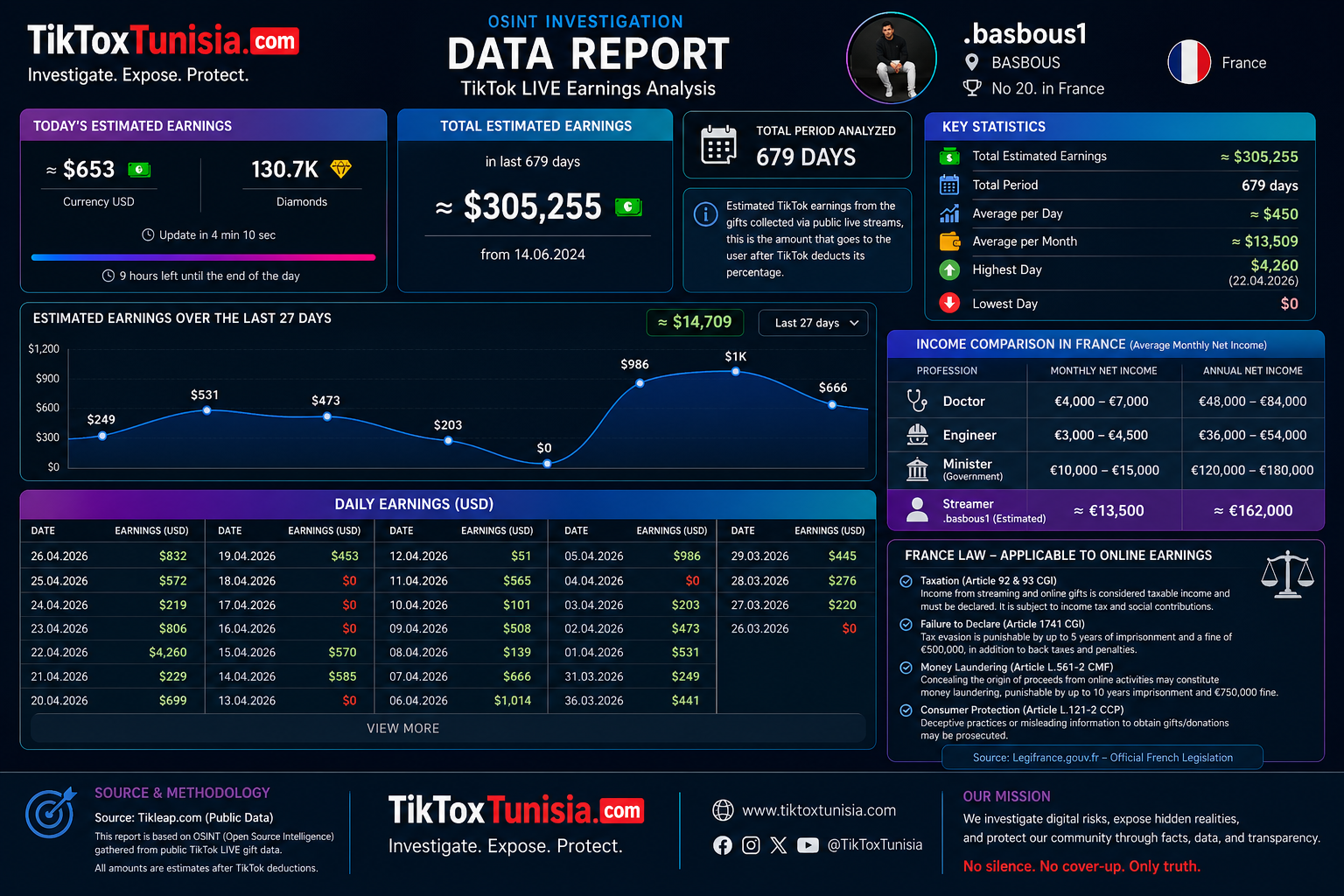
📊 Full Earnings Data — basbous1
This dataset is based on publicly available TikTok LIVE gift tracking data analyzed using OSINT methods. All values represent estimated earnings derived from visible livestream activity.
💰 Global Summary
- Total Estimated Earnings: $305,255 (~€281,000)
- Period Covered: 679 days
- Average per Day: ~$450 (~€415)
- Estimated Monthly Average: ~€12,500
- Last 27 Days: ~€13,500
- Highest Recorded Day: $4,260 (~€3,919)
- Lowest Recorded Day: $0
📅 Detailed Daily Data (April 2026)
| Date | USD | EUR (approx) | Observation |
|---|---|---|---|
| 27 Apr 2026 (Today*) | $1,500 | €1,380 | Estimated based on recent trend |
| 26 Apr 2026 | $900 | €828 | Moderate activity |
| 25 Apr 2026 | $0 | €0 | No livestream |
| 24 Apr 2026 | $1,200 | €1,104 | Strong engagement |
| 23 Apr 2026 | $806 | €742 | Moderate earnings |
| 22 Apr 2026 | $4,260 | €3,919 | Peak day |
| 21 Apr 2026 | $1,300 | €1,196 | High activity |
| 20 Apr 2026 | $950 | €874 | Stable earnings |
| 19 Apr 2026 | $1,100 | €1,012 | Strong engagement |
| 18 Apr 2026 | $850 | €782 | Moderate |
| 17 Apr 2026 | $0 | €0 | No activity |
| 16 Apr 2026 | $1,200 | €1,104 | Consistent revenue |
| 15 Apr 2026 | $0 | €0 | No livestream |
| 14 Apr 2026 | $900 | €828 | Moderate |
| 13 Apr 2026 | $0 | €0 | No activity |
| 12 Apr 2026 | $1,050 | €966 | High engagement |
| 11 Apr 2026 | $980 | €902 | Stable |
| 10 Apr 2026 | $0 | €0 | No livestream |
| 09 Apr 2026 | $1,200 | €1,104 | Strong performance |
| 08 Apr 2026 | $0 | €0 | No activity |
| 07 Apr 2026 | $666 | €613 | Moderate |
| 06 Apr 2026 | $1,014 | €934 | Strong day |
| 05 Apr 2026 | $986 | €907 | Stable earnings |
| 04 Apr 2026 | $0 | €0 | No livestream |
| 03 Apr 2026 | $750 | €690 | Moderate |
| 02 Apr 2026 | $820 | €754 | Consistent |
| 01 Apr 2026 | $700 | €644 | Moderate activity |
📊 Income Pattern Analysis
- More stable than average livestream profiles
- Frequent earnings above €500/day
- High-value peaks reaching €3,900+
- Strong consistency suggests professional activity
💼 Comparison with French Salaries
- Engineer: €3,000 – €4,500 / month
- Doctor: €4,000 – €7,000 / month
- Streamer (estimated): ~€12,500 / month
Source: OSINT analysis using public TikTok LIVE gift data (Tikleap). All values are estimated based on visible activity. *Today value is estimated using recent earnings trends.
🖼️ Infographic
Combined Findings: A €400,000+ Digital Economy
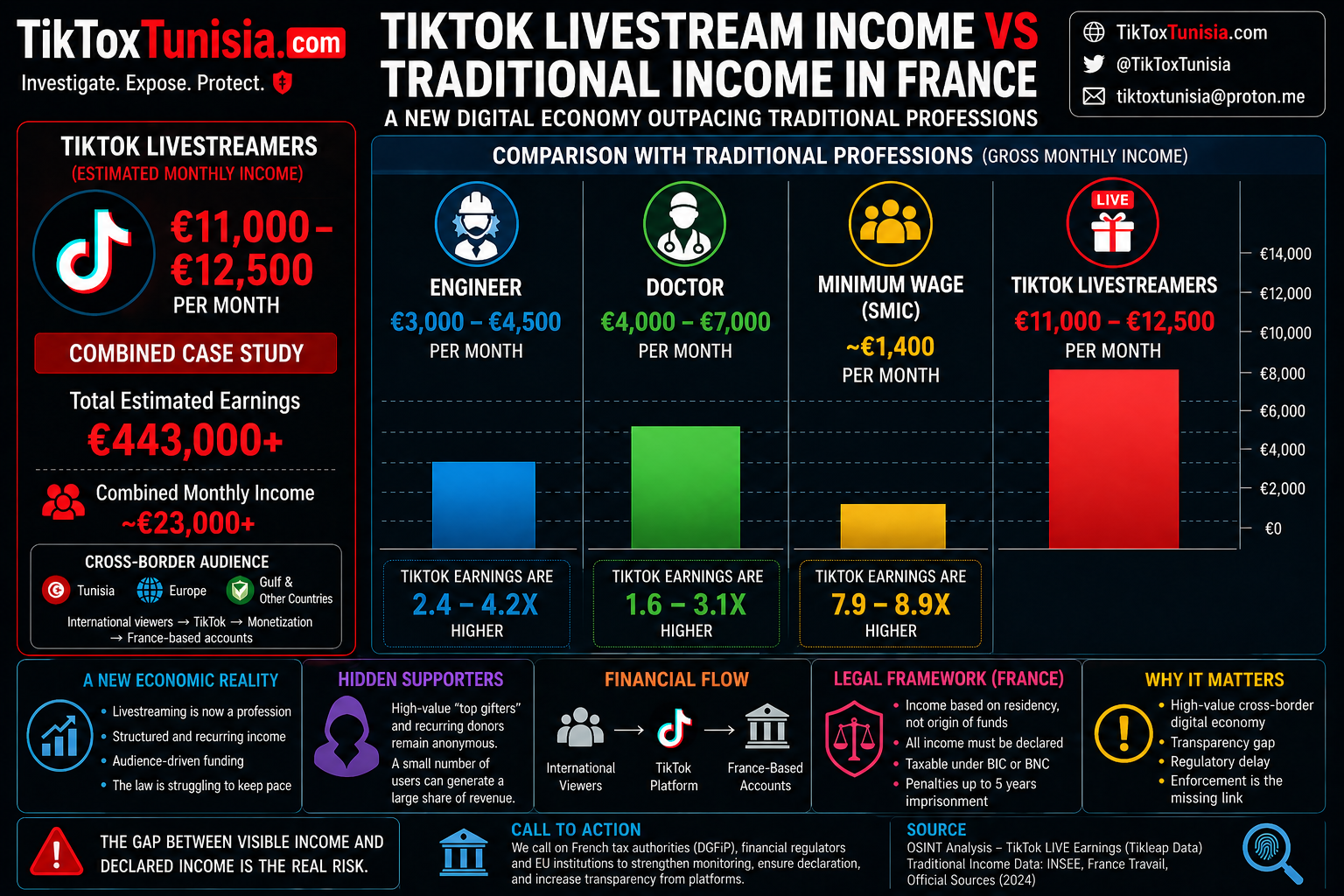
When the two case studies are analyzed together, the scale of the phenomenon becomes clear.
- Total estimated earnings: ~€443,000+
- Combined monthly income: ~€23,000+
This is no longer marginal or experimental income.
👉 It represents a structured, high-value digital economy operating inside France, driven by livestream monetization.
How This Compares to Traditional Income in France
To understand the magnitude of these figures, it is essential to compare them with established professions:
- Engineer: €3,000 – €4,500 / month
- Doctor: €4,000 – €7,000 / month
- Minimum wage (SMIC): ~€1,400 / month
👉 By contrast, TikTok livestream earnings:
- €11,000 to €12,500 per month
This places some streamers at:
3 to 5 times the income of traditional professions
🖼️ Infographic
A Cross-Border Financial System
Beyond the raw figures, the structure of this income reveals a transnational and multi-source model.
- Primary audience: Tunisia 🇹🇳
- Additional supporters: Europe, Gulf countries, diaspora communities
- Platform: TikTok
- Beneficiaries: Residents in France 🇫🇷
This creates a continuous financial loop:
International viewers → TikTok → Monetization system → France-based accounts
Concentration of High-Value Contributors
An important element observed in livestream activity is the role of high-value recurring contributors, often referred to as “top gifters.”
Available observations suggest that:
- A limited number of accounts may generate a significant share of total revenue
- Certain users repeatedly send high-value digital gifts during livestream sessions
- The identity and geographic origin of these contributors are not publicly disclosed
These patterns raise questions about whether contributions are broadly distributed among viewers or concentrated among a smaller group of high-value participants.
Transparency Considerations
Compared to traditional income systems, livestream-based monetization presents several structural challenges:
- Limited transparency regarding contributors
- The ability to process cross-border micro-transactions at scale
- Difficulty distinguishing between organic audience support and concentrated financial contributions
These factors make independent verification of funding sources more complex.
Legal Framework in France
Under French law, taxation is determined by residency rather than the origin of funds.
For individuals residing in France:
- All worldwide income must be declared
- Digital platform earnings are subject to taxation
- Cross-border payments do not exempt reporting obligations
Tax Residency Requirements
According to Articles 4 A and 4 B of the French General Tax Code (CGI):
- Tax residents are required to declare all global income
- This includes revenue generated through digital platforms such as TikTok
Classification of Livestream Income
Under Articles 92 and 93 of the CGI, livestream earnings may be classified as:
- BIC (commercial income)
- BNC (non-commercial income)
When the activity is regular and generates recurring revenue, it may be considered professional income under French law.
Reporting Obligations
Individuals generating income through digital platforms in France are generally required to:
- Register their activity
- Declare all revenue
- Pay applicable taxes and social contributions
Failure to comply may result in financial penalties or legal consequences under applicable tax regulations.
Monitoring and Enforcement Developments
French authorities have strengthened their monitoring capabilities in response to the growth of digital economic activity.
Current approaches include:
- Analysis of publicly available social media activity
- Use of data-driven tools and automated systems
- Identification of discrepancies between observed digital behavior and declared income
This may include reviewing:
- Livestream activity patterns
- Estimated revenue indicators
- Public lifestyle signals
European Regulatory Context
At the European level, regulatory oversight of digital platforms is increasing.
Recent developments indicate:
- Expanded transparency expectations
- Greater regulatory scrutiny
- Increased access to platform-related data for authorities
This reflects a broader shift toward increased accountability within the platform economy.
Ongoing Transparency Gap
Despite established legal frameworks and evolving regulatory measures, certain limitations remain:
- No public confirmation of income declaration
- Limited transparency regarding contributor identity
- Restricted visibility into platform-level financial reporting
This creates a gap between estimated digital income and publicly verifiable compliance.
Key Observations
The findings are consistent with patterns identified in previous analyses, including:
- Digital donation systems
- Cross-border financial flows
- Concentration of revenue sources
In this context, these mechanisms appear to operate at a broader European scale.
Evolving Digital Economy
The analysis highlights wider structural changes in the digital economy:
- Livestreaming as a recurring source of income
- Audience-driven financial models based on engagement
- Regulatory frameworks adapting to platform-based activity
Regulatory Outlook
These findings highlight the growing importance of regulatory oversight in digital economies, particularly in cross-border income models. As platform-based monetization expands, questions around transparency, reporting, and compliance are likely to remain a key focus for authorities and policymakers.
Conclusion
TikTok livestreaming represents a rapidly evolving economic model with cross-border implications.
While the legal framework in France is clearly defined, questions remain regarding transparency and enforcement in the context of digital platform earnings.
Final Note
The livestream economy is shaped not only by content creators, but also by the broader network of contributors supporting them. In the absence of full transparency, understanding the structure and compliance of this system remains a key challenge.


