

A TikTok livestream ends. The viewers disappear. But the money does not.
Within minutes, the gifts collected during the broadcast can be transformed into euros, USDT or cash. The transfer may pass through a PayPal account in France, a Paysera IBAN in Lithuania, a RedotPay card loaded with cryptocurrency or a Telegram group offering instant cash-out in Tunisia.
For the public, these streamers appear to be internet celebrities. For the Tunisian authorities, they represent a growing blind spot.
This investigation by TikToxTunisia.com examines how a new underground financial system has emerged around Tunisian streamers — and why the state has so far failed to stop it.
In Tunisia, the new economy is no longer built only in shops, factories or offices. It now exists on TikTok livestreams, Telegram groups, betting websites and cryptocurrency wallets.
Every night, thousands of Tunisian users watch local streamers ask for gifts, donations and “support.” Viewers send roses, lions, galaxies and expensive TikTok gifts that can be converted into real money.
Officially, that income should be declared, taxed and transferred through Tunisian banks.
In reality, much of it disappears.
Behind the public image of popular Tunisian TikTok creators, a parallel financial system has quietly emerged. Some streamers use foreign PayPal accounts, European bank cards, cryptocurrency and VPNs to hide their earnings from the Tunisian authorities. Others rely on intermediaries outside Tunisia, illegal betting websites, escort networks and Telegram groups where money can be exchanged without leaving a trace.
The result is a growing underground economy that the Tunisian government appears unable — or unwilling — to control.
TikTok Money in Tunisia: A Growing Industry Without Oversight
TikTok has become one of the most profitable platforms in Tunisia. Large livestreamers can receive hundreds or even thousands of dollars in gifts every week.
Many creators publicly claim that they earn very little. Yet their lifestyle often tells a different story: luxury cars, expensive apartments, constant travel, cash gifts and high spending.
Unlike traditional businesses, most Tunisian streamers are not registered as companies. They do not issue invoices, keep accounting records or pay taxes on their income.
There is no clear system requiring TikTok creators to declare:
- Livestream donations
- Sponsorship deals
- Advertising income
- Gifts received from followers
- Revenue from Telegram groups or private channels
This legal vacuum has allowed a new generation of influencers to operate in the shadows.
The scale of the money involved is one of the least discussed aspects of Tunisia’s TikTok economy. While many streamers publicly describe their activity as “small support” or “simple entertainment,” available estimates suggest a very different reality.
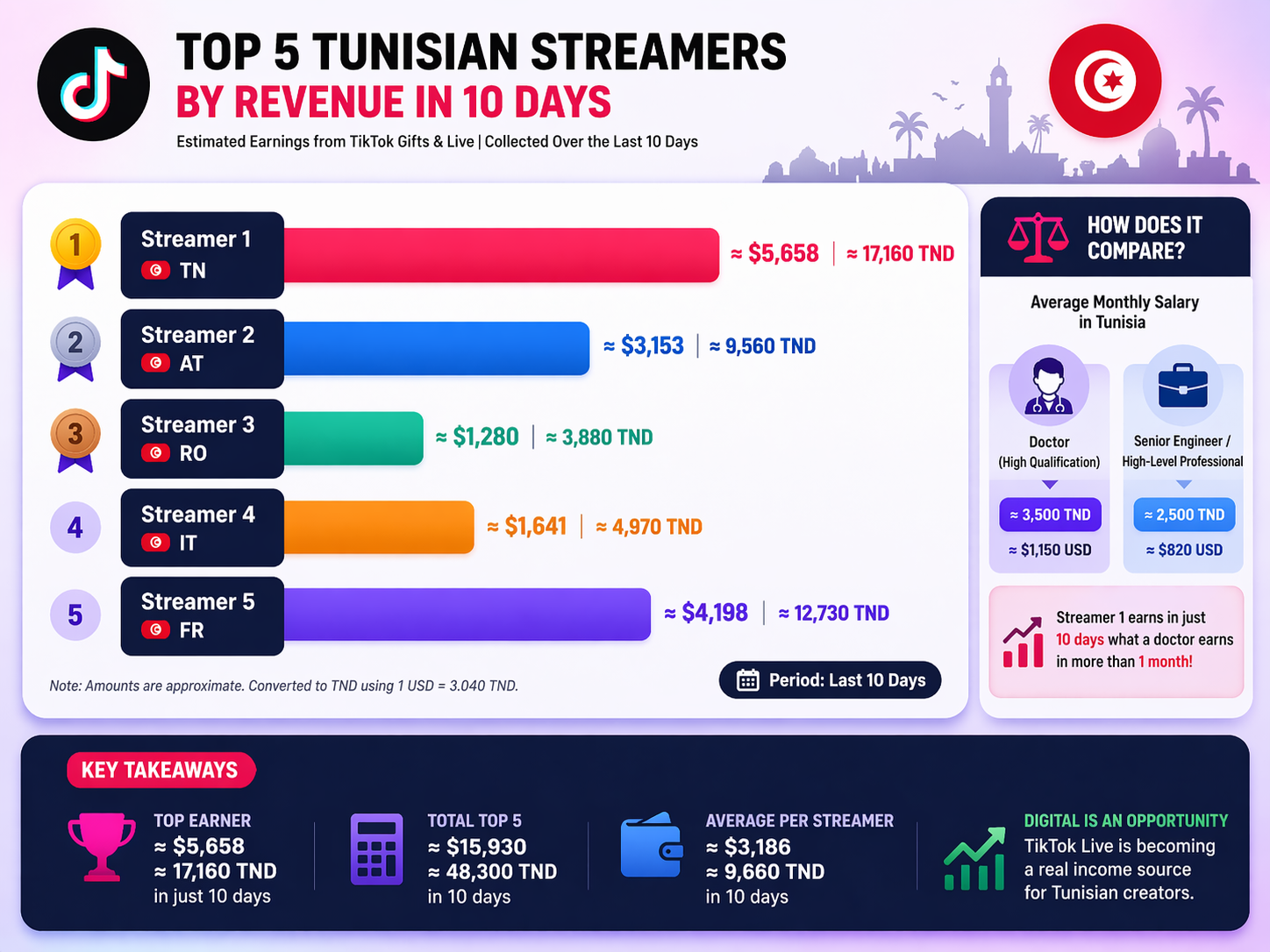
These figures help explain why a growing number of Tunisian creators no longer rely on local banks or official payment systems. When thousands of dinars can be earned in a matter of days, the temptation to move that money outside the reach of the Tunisian authorities becomes increasingly strong.
How Tunisian Streamers Hide Their Income
The most common method is simple: keep the money outside Tunisia.
Because Tunisia does not officially support PayPal and maintains strict foreign exchange controls, many streamers create accounts abroad.
Some use:
- A friend or relative living in Europe
- A foreign phone number
- A VPN connected to France, Turkey or the UAE
- A remote smartphone or self-hosted device physically located abroad
Once the account is created, TikTok payments are sent to:
- A foreign PayPal account
- A European IBAN through Paysera, MyFin or Bankera
- A prepaid Visa or Mastercard card
- A cryptocurrency wallet
The money never enters the Tunisian banking system.
Instead, it remains abroad until the streamer needs cash.
At that point, the funds are often converted into USDT or withdrawn through an intermediary.
A common system used by Tunisian streamers works like this:
- TikTok sends dollars or euros to a foreign account.
- The streamer converts the balance into USDT.
- A local buyer in Tunisia sends cash, D17 or a bank transfer.
- The streamer transfers the USDT.
- The money is now “clean” and invisible to the Tunisian authorities.
Entire Telegram groups now exist for this purpose. Some openly advertise:
- “Buy and sell USDT in Tunisia”
- “Cash out PayPal balance”
- “Withdraw TikTok money”
- “Paysera and RedotPay available”
The underground market has become so common that many young Tunisians consider it normal.
Tunisian Law: Why Hidden TikTok Income Could Be Illegal
Tunisia already has laws that could apply to hidden TikTok revenue, undeclared PayPal accounts and USDT transactions.
Under Tunisia’s foreign exchange rules, all transactions inside the country must normally be made in Tunisian dinars. Residents are not allowed to freely hold euros or US dollars abroad without authorization from the Central Bank of Tunisia.
Article 76 of the Tunisian Exchange Code prohibits:
- Undeclared foreign bank accounts
- Keeping euros or dollars abroad without authorization
- Using foreign cards or foreign payment accounts for undeclared activity
- Moving money outside Tunisia without approval
In theory, this means that a Tunisian streamer who receives TikTok money through PayPal, Paysera, RedotPay or a crypto wallet and does not declare it could be violating Tunisia’s exchange regulations.
Tax law may also apply.
According to Tunisia’s tax code, any regular online activity that generates money can be treated as taxable income. Streamers, influencers, TikTok creators and online sellers may legally be considered self-employed workers or small businesses.
Article 82 of Tunisia’s Tax Procedures Code allows tax authorities to investigate undeclared income and apply penalties.
Authorities could therefore argue that:
- TikTok gifts are undeclared revenue
- USDT cash-outs are hidden income
- Foreign betting commissions are taxable
- PayPal balances and foreign cards must be declared
The legal risks become even greater when betting or escort networks are involved.
Law No. 2015-26 on money laundering allows Tunisian authorities to investigate any attempt to hide the origin of money, especially when it involves:
- Cryptocurrency
- Foreign payment accounts
- Intermediaries
- Fake identities
- Transfers linked to betting, fraud or illegal services
If prosecutors believe that a streamer used foreign accounts, USDT or fintech cards to hide money, the case could move beyond tax evasion and become a money laundering investigation.
Why PayPal Is Still Not Available in Tunisia
For years, Tunisian freelancers and digital workers have demanded access to PayPal.
The Central Bank of Tunisia has repeatedly refused, arguing that unrestricted access to foreign currency would make it harder to enforce exchange regulations.
Under Tunisian law, residents are not supposed to:
- Hold undeclared accounts abroad
- Freely receive dollars or euros
- Keep foreign currency outside Tunisia
- Open foreign bank accounts without authorization
The Tunisian dinar is not freely convertible.
That means a Tunisian resident cannot simply receive money in dollars and spend it internationally.
As a result, a paradox has emerged.
The state blocks legal access to modern financial tools, but it has failed to stop people from using illegal alternatives.
RedotPay, Paysera and the Rise of the “Shadow Bank”
Since PayPal is unavailable, Tunisian streamers increasingly rely on foreign fintech platforms.
The most popular names today include:
- RedotPay
- Paysera
- MyFin
- Bankera
- MyPal
- Veritas
- Satchel
- Moneco
These platforms offer:
- European IBAN accounts
- Foreign Visa and Mastercard cards
- Virtual cards for online spending
- Cryptocurrency conversion
- International transfers outside Tunisia
RedotPay has become especially popular because it allows users to load a card directly with USDT.
A streamer can receive TikTok income, convert it into cryptocurrency and then spend the money through a RedotPay card without ever using a Tunisian bank.
Paysera and Bankera are widely used by online sellers and influencers because they provide a European bank account.
Many Tunisian users register these services using a VPN and the address of a friend abroad.
For some streamers, these fintech accounts have become more important than their local bank account.
The Hidden Role of VPNs and Remote Phones
One of the least discussed parts of Tunisia’s underground economy is the use of remote devices.
Several Tunisian streamers no longer manage their accounts from Tunisia.
Instead, they use:
- A smartphone physically located in France or Italy
- A remote desktop hosted abroad
- A private VPN server
- A foreign SIM card
This allows them to appear as if they are operating from another country.
Why does this matter?
Because many platforms restrict financial services based on location. A PayPal account opened from Tunisia may be blocked. A foreign account managed from a French IP address is much less likely to attract attention.
Some streamers even share tutorials explaining how to:
- Open a foreign TikTok account
- Hide their location
- Link PayPal to Paysera or Bankera
- Convert the balance into USDT
The techniques are no longer secret.
They are spreading rapidly across Telegram, Facebook and TikTok itself.
The Failure of Government Control
Officially, Tunisia has some of the strictest financial controls in the region.
In practice, those controls often exist only on paper.
The Tunisian government has failed to control:
- Cryptocurrency trading
- USDT peer-to-peer markets
- Illegal betting websites
- Hidden foreign accounts
- TikTok donations and livestream revenue
The authorities continue to monitor traditional businesses while a large part of the new digital economy operates in total opacity.
Tax inspectors can easily audit a restaurant, a shop or a small company.
But they struggle to trace:
- A PayPal account in France
- A crypto wallet on Binance
- A RedotPay card loaded with USDT
- A Telegram group selling betting accounts
The result is a system where ordinary employees pay taxes automatically, while a growing number of digital influencers earn money without declaring anything.
Illegal Betting: The New Source of Hidden Cash
TikTok money is only one part of the story.
Over the last two years, illegal online betting has exploded in Tunisia.
Foreign betting websites are now heavily promoted by some Tunisian influencers and streamers.
In many cases, the streamer is not only gambling.
They are also acting as:
- An intermediary
- A reseller of betting accounts
- A promoter for foreign gambling platforms
- A cash-out service for other users
The system often works through USDT.
A user sends cash or a local transfer. The streamer then deposits cryptocurrency into the betting website.
When the user wins, the money is returned through:
- USDT
- Paysera
- RedotPay
- Cash delivered in person
Some Telegram channels now openly advertise:
- “Recharge betting account”
- “Withdraw casino winnings”
- “Buy USDT instantly”
- “Fast cash-out in Tunisia”
Because the money never passes through Tunisian banks, authorities have almost no visibility.
From TikTok Gifts to Escort Networks
Another hidden source of money involves adult content and escort networks.
Several Tunisian pages and private Telegram channels mix livestreaming, private calls, explicit content and paid meetings.
Some influencers use TikTok only as a way to attract clients.
After the livestream ends, users are redirected to:
- Telegram groups
- WhatsApp numbers
- Private Snapchat accounts
- Foreign payment links
Payments are often requested through:
- PayPal accounts abroad
- USDT wallets
- Paysera transfers
- Gift cards
This creates another layer of hidden income that is rarely declared.
According to several online investigations and user testimonies, some Tunisian pages now combine:
- TikTok livestreams
- Betting promotions
- Escort advertisements
- Cryptocurrency cash-outs
The same networks that hide TikTok income are often used for these activities as well.
Why So Many Young Tunisians Join the Underground Economy
The popularity of these systems is not only about greed.
Many young Tunisians say they have no other option.
Tunisia still does not offer:
- Official PayPal access
- Easy international payments
- Modern online banking
- A clear legal status for freelancers and streamers
- Practical ways to receive foreign income
As a result, young people turn toward whatever works.
A student who wants to sell designs online may need Paysera.
A streamer who earns money from TikTok may need USDT.
A freelancer who works with foreign clients may use RedotPay.
Little by little, the underground system becomes normal.
The Hidden Digital Economy: TikTok, Crypto and Anonymous Money
Tunisia still has some of the strictest currency controls in North Africa. The Tunisian dinar is not freely convertible, international payment systems remain limited and foreign currency transactions are heavily regulated.
For thousands of Tunisian freelancers, developers, online sellers and TikTok streamers, receiving money through normal banking channels is often difficult or impossible.
As a result, a parallel digital economy has emerged.
Today, many Tunisians rely on:
- TikTok gifts and livestream donations
- Cryptocurrency, especially USDT
- Telegram exchange groups
- Anonymous intermediaries
- Cash networks operating outside the banking system
For some, these systems are not a luxury. They are the only way to work.
Freelancers use them to receive payments from European clients. Streamers use them to cash out TikTok earnings. Young Tunisians use them to buy software, subscriptions and online services that cannot be paid for with local bank cards.
But the same grey economy also creates serious risks:
- Tax evasion
- Fraud and scams
- Anonymous transfers
- Money laundering
- Hidden circulation of foreign currency
Critics increasingly argue that Tunisia now has two separate economies.
The first is the official economy, where workers, engineers, doctors and small businesses struggle under taxes, bureaucracy and low salaries.
The second is the hidden economy, where money moves faster, more discreetly and often without any meaningful control.
This is one of the deepest failures of the Tunisian state. The government failed to modernize the banking system, and an uncontrolled digital market emerged in its place.
Corruption, Tax Evasion and the Collapse of Trust
The rise of the hidden digital economy cannot be separated from the broader crisis of corruption and mistrust in Tunisia.
According to Transparency International, Tunisia scored only 39 out of 100 in the 2025 Corruption Perceptions Index, placing the country around 91st–92nd in the world.
At the same time, Tunisia is estimated to lose more than 5.2 billion dinars every year because of tax evasion, smuggling, undeclared activity and the informal economy.
Corruption continues to affect:
- Customs and border crossings
- Public contracts
- Business licenses
- Local administration
- Recruitment and public sector jobs
- Access to justice and public services
For many Tunisians, this creates a dangerous feeling that the system is not simply weak, but designed to protect those who benefit from it.
Key Figures
- Corruption score: 39 / 100
- Global rank: 91–92 / 180
- Annual losses from tax evasion: more than 5.2 billion dinars
- Informal economy: more than 35% of GDP
- Public debt: more than 80% of GDP
The Rise of Drugs, Trafficking and Money Laundering
Economic stagnation and weak oversight have also created new opportunities for criminal networks.
In 2025, Tunisia registered more than 14,300 drug-related cases and more than 20,000 arrests linked to drug trafficking and consumption.
Cannabis remains the most common substance, but synthetic drugs, pills and cocaine are becoming more visible, particularly in major cities.
At the same time, Tunisia increasingly appears in international reports as a transit point between North Africa and Europe for:
- Drug trafficking
- Money laundering
- Smuggling
- Human trafficking
- Prostitution and escort networks
Although there are no official figures on escort networks, international investigations repeatedly identify Tunisia in cases linked to sexual exploitation and trafficking.
Organizations such as FATF, MENAFATF and the Basel AML Index continue to warn that Tunisia remains vulnerable because of:
- The size of the informal economy
- Weak controls on cash transactions
- Corruption
- Cryptocurrency and anonymous transfers
- Cross-border smuggling networks
One of the most concerning developments is the connection between TikTok money and this broader underground economy.
TikTok gifts can be converted into cryptocurrency. Cryptocurrency can then be exchanged through Telegram groups and finally transformed into cash without ever entering the official banking system.
TikTok Gifts → USDT / Crypto → Telegram Exchange Groups → Cash Networks
In this parallel system, money often moves faster than the Tunisian state can follow.
The Social Cost of Hidden Digital Money
The rise of hidden online income has serious consequences.
First, the state loses tax revenue.
Millions of dinars may be circulating outside the official economy every year.
Second, criminal activity becomes easier to hide.
The same methods used by streamers can also be used for:
- Fraud
- Blackmail
- Betting networks
- Escort rings
- Money laundering
Third, ordinary Tunisians lose confidence in the system.
Many citizens now believe that the rules only apply to workers and small businesses, while influencers and online personalities can avoid taxes and restrictions.
This creates a dangerous sense of injustice.
Power, Politics and the End of the Promise
When President Kais Saied came to power, many Tunisians saw him as a chance to break with the corruption and dysfunction of the post-2011 period.
He promised to fight corruption, punish the political class and defend ordinary citizens.
But after July 25, 2021, Tunisia entered a different political phase.
Parliament was suspended and later dissolved. The Supreme Judicial Council was dismantled. More and more power became concentrated in the presidency.
One of the most controversial measures was Decree-Law 54 of 2022, officially presented as a law against fake news and cybercrime.
Human rights organizations argue that the decree has often been used against journalists, activists, opposition figures and citizens critical of the government.
At the same time, judges were removed, institutions became weaker and fear replaced political debate.
The contradiction becomes even more striking when looking at public finances.
While inflation continues and unemployment remains above 15 percent, the budget of the Presidency reached nearly 229.7 million dinars in 2026. Around 173.8 million dinars are allocated to presidential security and protection.
For many Tunisians, the message is simple: the state still has money, but not for them.
From the “10 Black Years” to Another Disappointment
Many Tunisians describe the period after 2011 as the “10 black years” — a decade marked by corruption, instability and weak economic growth.
But by 2026, more and more people believe that the years under Kais Saied did not solve those problems.
Instead, Tunisia moved from one disappointment to another.
The names changed, but the same issues remained:
- Corruption continued
- Prices increased
- Graduates emigrated
- Criminal networks expanded
- Trust became weaker
For many Tunisians, the country no longer feels like a nation moving forward. It feels like a country surviving from one crisis to the next.
Tunisia’s Digital Economy Is Growing Faster Than Its Laws
The real problem is not only the streamers.
The real problem is that Tunisia’s laws belong to another era.
The country still treats foreign currency as if the internet did not exist.
Meanwhile, a new generation is already living in a world of:
- TikTok income
- USDT
- Telegram groups
- Foreign fintech cards
- Remote work
- Cross-border digital business
The authorities continue to rely on old rules that no longer match reality.
The result is predictable.
Every restriction creates a new workaround.
Every blocked payment service creates a new Telegram market.
Every attempt to control dollars and euros pushes more people toward cryptocurrency.
What Should Tunisia Do?
If the government wants to reduce hidden income and regain control, repression alone will not work.
Tunisia needs:
- Official PayPal and Stripe access
- Clear tax rules for streamers and influencers
- Legal foreign currency accounts for freelancers
- Modern fintech regulation
- Stronger investigations into illegal betting and criminal networks
- Better oversight of TikTok donations and digital advertising
Without these reforms, the underground economy will continue to grow.
And every year, more money will move from TikTok to Telegram to USDT without ever appearing in the official economy.
Conclusion
The new face of Tunisia’s underground economy is no longer a smuggler crossing the border.
Today, it is a streamer broadcasting live from a bedroom, collecting gifts on TikTok, cashing out through USDT and spending the money with a foreign card.
Although the tools have become more sophisticated, the underlying issue remains the same: a large and growing part of Tunisia’s economy continues to operate outside official oversight, beyond the reach of tax authorities and existing financial regulation.
The Tunisian government still struggles to control hidden money, illegal betting and undeclared income. But instead of adapting to the digital world, it continues to rely on laws written for another time.
Until Tunisia modernizes its financial system, hidden digital money will remain one of the country’s fastest-growing industries.


